|
Industrial logging practices are not designed to benefit private
landowners; they are not designed to protect forest lands. Industrial
logging practices are designed to benefit the timber and pulp industry by
getting trees off the land and into the mills as quickly and cheaply as
possible. The huge multinational timber corporations are not concerned
with whether the forest landowner makes as much money from their land as they
could have or even whether the forest landowner's land is still viable after
logging. The corporations' concerns are maximizing next quarter's profits
and driving up share prices.
When forest land is logged recklessly just to maximize timber and
pulp production in the present, the land suffers over the long term. Wildlife, biodiversity,
water quality, air quality, and scenic beauty all suffer as well. The forest
landowner also suffers by not realizing the maximum economic return from their
land and from the loss of all the non-economic values and resources that make a
person's land mean much more to them than just property. When land is treated as nothing but industrial resources and
forests are managed merely as commodities, the environment and the private
landowner both suffer. Industrial demand for cheap fiber has caused
massive clearcutting of southern forests. Instead of trees being allowed
to mature and provide valuable sawtimber for local sawmills, forests are
clearcut young and fed into chip mills. The chips are then shipped
overseas to be made into paper and other products there. Value-added jobs
are lost. Studies show that for every one job created by clearcutting and
chip mill use of the timber, 40 jobs in the cabinet and furniture industries
here in America are lost. This industrial row cropping of trees has also
driven prices for timber to new lows, thus forcing many small operators, family
sawmills and private landowners into selling out to the multinational
corporations cheaply. Causing a world glut of timber fiber benefits the
multinational corporations by allowing them to buy up small competitors and
timber at prices that allow them to consolidate power over the timber
market. Doing business on a global scale, these corporations do not care
if their practices cause harm to a regional economy. According
to Harvard professor (and Alabama native) Dr. Edward O. Wilson, conversion of
natural forests to pine plantations can cause a loss of 95-99 percent of the
biodiversity that was part of the forest. Wildlife suffers when natural
forests are replaced with plantations or development. 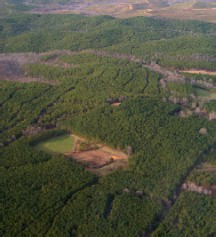 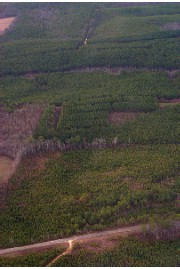
Below
is a chip
mill on the Tenn-Tom waterway, which is a major route for shipping the chips of
southern trees to Asia. The number of chip mills in the South has
skyrocketed in the past ten years, most of which are used to funnel southern
hardwoods to Asia.

Land is more than just property. Forests are more than
just timber.
Individual landowners realize these truths. Local
sawmills that produce the lumber than gets turned into products locally also
know these things. Multinational corporations do not. Unfortunately,
the private forest landowner often gets "advice" about how to manage their land
only from those corporations and people who have a vested interest in the global
timber market. Corporations and the foresters who work for the industry
usually do not provide forest landowners information about real alternatives to
industrial logging practices and do not give them assistance with long-term
protection of their land. The Sustainable Forests Alliance does.
Trails for log skidders and log trucks can cause massive erosion and
damage, like this incredible damage below from a clearcut in northern Alabama.
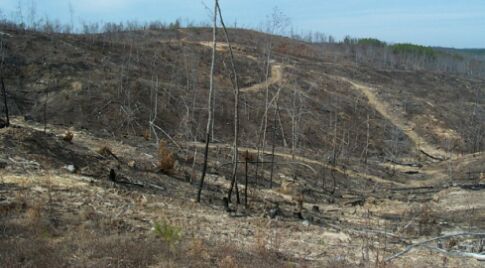
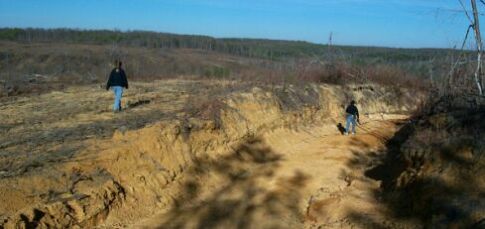 Skid trails throughout this clearcut below cause erosion, even many
months (and even years) after the area was logged, and act as funnels sending
sediment down into the stream below.
Skid trails throughout this clearcut below cause erosion, even many
months (and even years) after the area was logged, and act as funnels sending
sediment down into the stream below.
|
