sustainable forestry
|
|
cut-to-length logging
|
|
|
|

|
|
|
Research
has shown that CTL logging has clear benefits for the landowner who wants to
profit from their timber but maintain the structural and biological integrity of
their land. Some of the benefits of the CTL methods identified by forestry
researchers are: greater adaptability for use in small logging areas or partial
cuts; the possibility exists to haul sawlog-length boles, minus their tops, that
are destined for chip use; allows for on-site sorting versus hauling to an
alternate location; the CTL harvester has a greater reach than the full-tree
feller buncher, CTL equipment is narrower and more compact and there is greater
maneuverability in the harvesting head. In addition, there is no roadside slash
since it is left behind as a ground mat. Overall, existing natural growth is better protected and ground disturbance is less than what occurs
with the common full-tree length skidder technique. The disadvantages of CTL
equipment have been identified as: requirement for a major time investment in both
classroom and on-site training; productivity can be hindered on small tree size
stands or dense stands, resulting in higher costs; the complexity of the
machinery increases maintenance needs. Furthermore, the existing investment in
full-tree equipment is substantial, and switching to other equipment must be a
carefully calculated decision. US Forest Service
publications show that CTL has advantages for the logger. Advantages include:
1) more economical on small tracts of timber; 2) less total labor cost, since
only two employees are needed; 3) less fuel consumption by machines; 4) easier
to merchandise highest valued products from trees; 5) Cut-to-length systems
range from lowest worker's compensation rates; 6) safe and comfortable work
environment; and 7) minimal site and stand damage. Disadvantages include: 1)
somewhat longer learning curve for operators; and 2) high initial cost of
individual cut-to-length equipment. The research is clear:
the disadvantages of CTL methods are mainly in the start-up costs and
training and maintenance for the CTL equipment owner. For the logger who
has clients who have small tracts needing harvest or who want uneven-aged
methods used, CTL is superior to traditional harvest methods. Once CTL
equipment is available in an area, the benefits to the landowner are
significant, with little to no downside. The use of CTL equipment and
methods produces timber and profits with much less adverse impacts to soils,
water quality, wildlife and the remaining timber on the land.
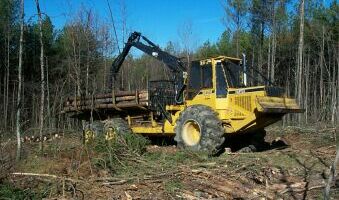 A forwarder is a piece of equipment that carries logs from the stump to the trucks without skidding them along the ground.
U.S. Forest Service research shows that this machine greatly reduces erosion and soil loss when
compared to the traditional log skidder. A forwarder is a piece of equipment that carries logs from the stump to the trucks without skidding them along the ground.
U.S. Forest Service research shows that this machine greatly reduces erosion and soil loss when
compared to the traditional log skidder.
Skidders pull logs behind
them, and as they move through the forest, the dragged logs tear bark off the
trees that are left standing. And a skidder must make many passes through
the forest to carry out the same amount of timber as a forwarder does in one
trip. When one wants to selectively log or thin a stand of trees, the use of
skidders can damage and even kill many of the trees that are purposefully left
standing. That can drastically reduce the future value of the remaining
trees, both biologica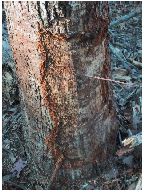 lly
and economically. lly
and economically.
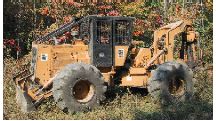
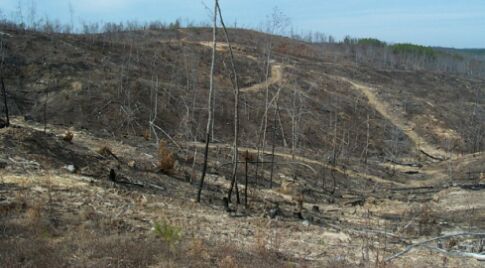
Trails for log skidders and log trucks can cause massive erosion and damage.
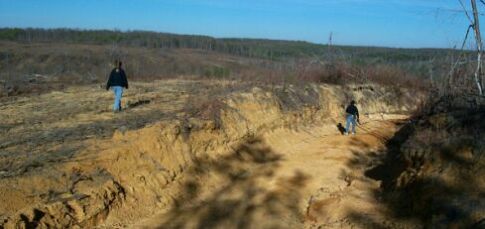 Skid trails throughout this clearcut cause erosion and act as funnels sending
sediment down into the stream below.
Skid trails throughout this clearcut cause erosion and act as funnels sending
sediment down into the stream below.
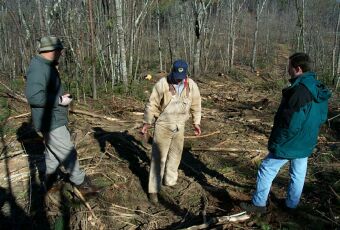 Unlike a
trail made by a log skidder which can tear up the ground and cause massive ruts, a forwarder trail causes little erosion.
Further, adding limbs and other woody debris to the trail reduces rutting and compaction and adds nutrients to the soil, thus speeding up recovery time for the land.
|