|
Restoration, Maintenance, and Harvest - This man's system allows more
flexibility for healthier forest management in the 21st Century
Article from Wild Alabama magazine.
The U.S. Forest Service in Alabama has recently begun discussing a plan to
restore the National Forests to their native composition. The Bankhead National
Forest contains tens of thousands of acres of pine plantations that have been
planted where hardwoods once grew. The agency is exploring the feasibility of
selectively removing the loblolly pines and allowing the original hardwood
stands to regain their rightful place in the forest. They call this management
prescription "restoration" and it will call for a gradual removal of
the existing pine plantations. The basic concept is to thin out the loblolly
pines while at the same time protecting the upcoming hardwoods. This process
will require special care from the contracting timber company that contracts to
do the work.
In order to protect the soils and scenic quality of the public lands it
will take decades to bring about restoration. All of this brings us to the
subject of this article: Better equipment for the 21st century New logging
equipment that is used in Canada, the northern U.S. and almost exclusively in
Sweden and other European countries has come to north Alabama.
Not since the days of mule and horse logging has the forests been so
little impacted by logging equipment. The new machines don't leave skid trails
and have smaller and fewer log landings. Clearcuts are rarely seen in Minnesota,
Michigan or European countries where logging has become almost an exact science.
Many landowners in northern states do not allow their lands to be clearcut.
Progressive landowners in Alabama are following suit. Most folks today want a
combination of good wildlife habitat, beauty and perhaps a steady supply of
sustainable high grade hardwoods that end up as furniture rather than chipboard
or paper. In most cases, this eliminates the need for clearcutting their
land.
Enter the New Logger
Donnie Williams is a 45 year old logger who cares about the land. He is a
first generation logger and a fourth generation farmer. For the last ten years
much of his work has been on the Wheeler Wildlife Refuge on the Tennessee River.
He also worked off and on in the Bankhead National Forest in the 1980's. Donnie
is a highly specialized logger who uses unusually gentle machines. The equipment
consists of a track-mounted processor, which cuts and de-limbs the trees,
measures lengths and diameters to cut logs to the most profitable length, and
then piles them aside to be picked up later by the forwarder. The forwarder
picks up the logs, places them into a cradle and carries them to a log trailer.
With a skilled operator in each machine, the trees designated for removal are
processed at the stump and removed from the site with little impact to the soil
or remaining trees.
We've all seen land that has been abused by poor logging practices. This
includes eroded mountainsides where the soils have washed away. We have
witnessed the destruction of wildlife habitat and driven by an ugly countryside
that takes years for the trees to grow tall and thick enough to hide the damage.
It would be unfair to judge all loggers for the sins of a few. While greed for a
few extra bucks might tempt landowners and loggers alike to cut as much as
possible at one time, there are many loggers who want to see Alabama have a
healthy and sustainable forest not only to insure sustainable jobs in the forest
but to leave the land healthy and productive for their children.
What's the Plan, Anyway?
To begin with, every forest landowner has their own ideas about what they
want from their land. Some want an emphasis on wildlife and aesthetics. Others
want to make money from timber or other forest products. Still others manage the
land for recreation. While not required by law, it is a good idea to get the
opinion of a registered forester before allowing any cutting on your land. You
need to know how much timber is on your property, what plant and animal species
would be impacted, and what your options are available to implement your
management plan.
The Place We Visited
Wild Alabama went into the woods where Donnie had an active operation
going. This particular property is located along the Tennessee River and
contains some sensitive areas located in hardwood bottoms. The landowner wanted
two things: wildlife enhancement and to produce high quality hardwoods in the
future. Donnie's plan was to take out some trees that were competing with some
high dollar trees such as the red oaks. In the area we looked at this meant some
gums and hackberries would be sold for pulpwood. In addition there were some
pines, the smaller of which would be added to the pulpwood sale and the larger
which would be sold for saw timber. Secondly, the fruit bearing trees would be
left for wildlife. Oaks, hickories, dogwoods and persimmons fall into this
category. This still left a mixture of several valuable species of trees that
would be left to grow to a larger size. Cherrybark oak is one valuable furniture
material.
What Donnie was doing was basically a selective thinning of the forest. It
takes an experienced person to thin hardwood trees. If the forest canopy is
opened up too much, pin limbs will sprout out along the tall straight trunks.
This ruins the value of the tree for veneer making. I was impressed with the
looks of the forest after the operation. Except for the limbs scattered around
the ground, you could hardly see much sign of timbering. Donnie believes that if
landowners would contract operations such as his, they could create a sustained
income over a period of time by taking out marketable trees on regular intervals
of 5 to 10 years. This is a great contrast to a degraded clearcut property where
soils are washed away in the process of growing pine monocultures that bring
little profit come market time. While he might not produce enough income with
one-time, random jobs, Donnie believes he could successfully compete with
clearcutting operators if he built a contract clientele where he would
periodically work their forest on regular intervals.
His operation can also do a superior job of thinning pine plantations. He
sends the processor straight into the stand. The machine can reach out and take
out selected trees, usually about four rows on either side. The ground in these
four rows is left undisturbed. The act of spreading the brush along the row
where the machine works lessens the impact to the soil.
A Rolling Sea of Pines
Alabama has 5.5 million acres of pine plantations. These tree farms are
grown primarily to feed pulp mills that make paper. Pulpwood is the top timber
market but not the only market. Pines grown for sawtimber are a second market.
High quality hardwood and pine production might be the best way to keep your
forest in top shape and make money too. For example, 13" dbh (diameter
breast high) red oaks are cut every day and sold to companies such as Champion
International for pulp. The landowner might get a few dollars for it now but
this tree would double in value in 10 years. Instead of going into the obscure
vats of yucky pulp, it would end up as expensive veneer or hardwood furniture.
This type of forest would be one with larger trees, older trees, more open and
more stately. Selectively harvesting maturing hardwoods and pines would hardly
be noticeable. The intact canopy protects the integrity of every strata of life
- from the soil organisms to the larger animals.
Traditional logging practices - clearcutting versus selection logging;
skidding versus carrying
Today's logging practices cause too much disturbance and damage to the
ground because of the way logs are handled. This holds true even in selective
cutting which is rarely done anymore because of the widespread belief that more
money can be made faster by cutting everything down. Many arguments can be made
for other benefits that might be come over a longer period of time. It is hard
for people to change a system of practices that have been carried on for a long
time. In conventional logging operations, a tree is cut down either by hand or
using a fellerbuncher. The log is dragged out of the woods to a log landing
where the trees are piled up in large piles. The act of dragging logs across the
soil tears up the vegetation, compacts and exposes the soil and knocks the bark
off of trees in the way. Deep ruts can be left in the trails and collector roads
resulting in root damage to remaining trees.
Donnie Williams' equipment that has far less impact than conventional
logging equipment. There are two pieces of machinery. The first is a small tree
harvesting machine that goes into the stand of trees. It has an arm that can
reach out 25 feet in any direction since the arm operates off of a turret that
can turn 360 degrees. The processor head at the end of the boom grasps a tree
near the base, stabilizes it, and cuts it off near the ground. While the tree is
still in the grip of the arm, a computer measures the diameter and sets the
length which the tree will be cut. The tree is pulled through the head delimbing
it, cuts it to length and lays it gently in a small stack. After it cuts the
trees designated for removal in one area, it moves on and the second machine
rolls in on rubber tires. It picks up each tree and loads it in a craddle on
itself and carries the logs out.
A technique used by Donnie in wet weather or damp soils is to lay out
piles of limbs along the projected path of the processor. The limbs keep the
machine from digging up or compacting the soil. The limbs, leaves and debris are
scattered around the forest floor. The benefits of this practice are not well
understood by the public who thinks it looks messy. Anybody who understands the
practice of mulching or composting should immediately see that debris is good
for the land. Soil moisture is held in the topsoil while the leaves, bark and
wood decomposes. Habitat for everything from salamanders to rabbits is created
or enhanced. The decomposing wood and leaves are nutritious to soil processes
and the combination of moisture, nutrients and sunlight causes trees to grow
faster.
In managing stands that contain quality oaks, sunlight and water are two
key ingredients for success. By taking out some competing trees too close to the
oaks, there will be more sunlight and moisture. "A lot of landowners are
reluctant to let a logger on their land. I feel I can improve their forest using
this equipment," says Donnie. He and his operators have been using this
equipment for 2 years now and have tried several techniques that will lessen the
impact on the environment. "We are now more experienced and feel we have
the tools and knowledge to improve a landowners forest."
Last year Donnie took a trip to Wisconsin and Michigan. He took a 300 mile
driving tour of timberlands to visit logging operations. He also visited
factories that built the cut to length harvesting system he operates, Fabtec
Inc. and Timbco. He was impressed with the cut to length logging operations he
saw. They took care of the land as well as cut the wood needed to produce the
timber products demanded by the public. He was also impressed that he did not
see but one 3 acre clearcut on the entire 300 mile drive. What he saw was a sea
of growing forest that was being thinned on a continuous schedule.
We encourage more private landowners to utilize these new innovative
logging practices on their lands. We also encourage the U.S. Forest Service to
use this equipment and these methods in sensitive areas as they restore the
Bankhead National Forest. For more information Contact: Donnie Williams, P.O.
Box 430, Somerville, Al. 35670 or Email: donniewilliams@mindspring.com.
Photo: The processor head has the capabilities to cut the tree and laying
it in a 360 degree area selected by the operator to be the least damaging to
surrounding trees. After cutting the tree close to the ground the computer
controlled sensor senses the log lengths and diameters as the tree is pulled
through the delimbing knives by hydraulic rollers, the trunk is then cut into
sections of optimal length for the targeted use and sale values. Cutting the
trees to length at the stump provides composting material for the forest and
eliminates the need for large loading areas.
Photo This is the big difference in harvesting methods. Normally, a log
skidder drags the logs out of the woods as whole trees. Skidding whole trees
from the woods not only damages the remaining trees and their roots, but also
compacts the soil and leaves rutted corridors through the forest. Donnie's
system cuts trees to length and stacks them where they grew. They are then
loaded onto the forwarder which has rubber floatation tires. This machine walks
lightly with a minimum of soil disturbance and tree damage. U.S. Forest Service research shows that this machine
greatly reduces erosion and soil loss when
compared to the traditional log skidder.
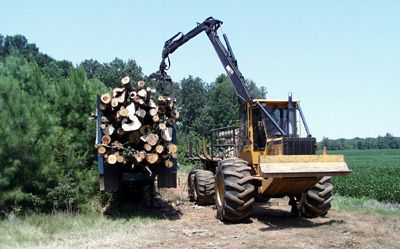
Photo: Further, adding limbs and other woody debris to the trail reduces rutting and compaction and adds nutrients to the soil, thus speeding up recovery time for the land.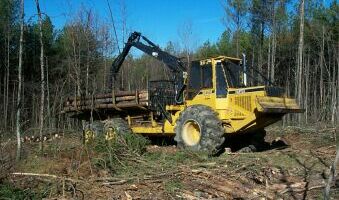
|
