
|
|
|
In Louisiana, Travis Taylor has taken to
cut-to-length logging in a big way. He owns four sets of CTL equipment, an
investment of over $3,000,000 in sustainable forestry. Having worked the
traditional tree-length logging methods for decades, Travis saw that there was a
better way to harvest, a way that would have far fewer impacts on the soils,
water and wildlife. He has so far established one of the largest and most
successful CTL operations in the country.
In a recent demonstration logging project in
October 2001, Travis and his crews showed what their CTL equipment could do in
heavily overstocked loblolly pine stands. This demonstration was held on
Winn Ranger District of the Kisatchie National Forest in Louisiana, and it
showed loggers and private landowners that thinning operations could be done
gently, efficiently and with less adverse impact on the soils and the trees that
were left.
Travis uses
Ponsse CTL equipment.
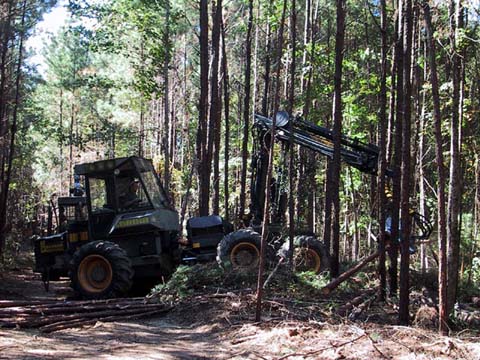 Above, a harvester reaches up to 30 feet into a stand to cut and remove trees
without damaging the trees that are left to grow.
Above, a harvester reaches up to 30 feet into a stand to cut and remove trees
without damaging the trees that are left to grow.
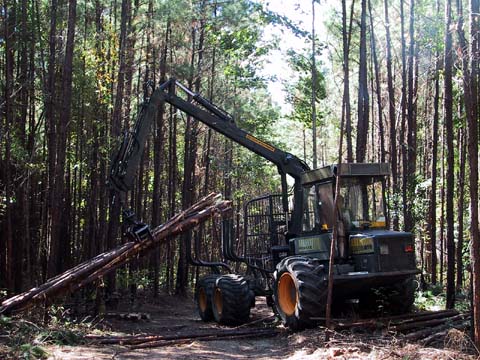 The
forwarder then collects the trees and takes them out to log trucks without
damage to the soils or other trees. The
forwarder then collects the trees and takes them out to log trucks without
damage to the soils or other trees.
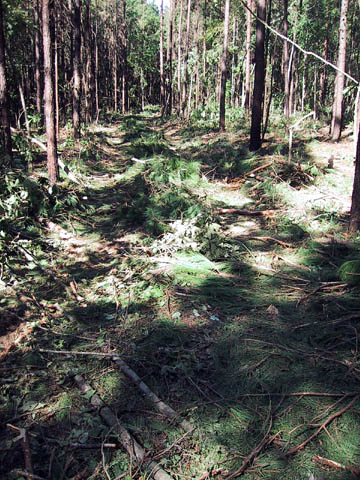 The
limbs and leaves of the trees are removed as the trees are cut. Then, the limbs
are spread on the travel ways that the harvester uses to prevent compaction,
rutting and erosion. Some 80% of the nutrients in a tree are in the limbs
and leaves; the CTL methods leaves those nutrients in the forest to nourish the
soil instead of hauling them out to a slash pile near the truck landing. The
limbs and leaves of the trees are removed as the trees are cut. Then, the limbs
are spread on the travel ways that the harvester uses to prevent compaction,
rutting and erosion. Some 80% of the nutrients in a tree are in the limbs
and leaves; the CTL methods leaves those nutrients in the forest to nourish the
soil instead of hauling them out to a slash pile near the truck landing.
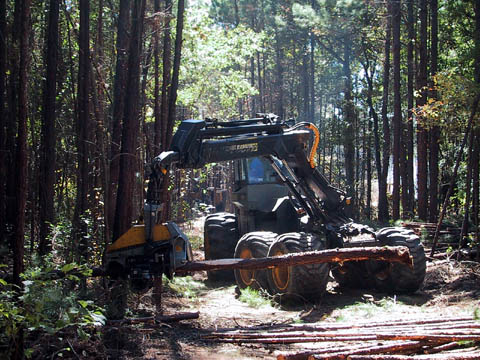 The
work of the harvester is controlled by a computer and is very precise; there is
little waste. Workers also benefit from this system as they stay in
enclosed cabins that are air-conditioned and heated and out of the way of bugs.
Being in these cabins makes the jobs of cutting and hauling the trees much safer
also. The
work of the harvester is controlled by a computer and is very precise; there is
little waste. Workers also benefit from this system as they stay in
enclosed cabins that are air-conditioned and heated and out of the way of bugs.
Being in these cabins makes the jobs of cutting and hauling the trees much safer
also.
|