general information
|
se forestry project |
|
|
|
|
resources by state
|
|
|
|
|
|
|
|
|

|
|
|
The Sustainable Forests Alliance developed the Southeast Forestry
Project to provide landowners information and free legal and forestry assistance
to help them make better and more informed choices about how they manage their
forests. This web site is the central location for that information.
The Alliance is also developing brochures, videos and landowner guide books to
help forest owners protect their land while making money.
Also, the Alliance seeks to assist landowners to keep their forests as
forests in perpetuity. Despite all the rhetoric from groups controlled by
multinational timber corporations, the reality is that environmental
organizations like those in the Alliance have much more in common with
individual forest landowners than the corporations do. While corporations
decry government "regulations" limiting forestry, the reality is that
there is virtually no regulation of the timber industry in the South at
all. Indeed, the biggest threat to forests is the same threat to wildlife,
water quality and other environmental interests: the loss of forests and habitat
due to conversion to farms, strip malls, subdivisions and parking lots.
Environmentalist organizations, like those in the Alliance, recognize that the
forest landowner is a friend of the environment, a person who loves and cares
for their land. Even a poorly managed forest is better for the environment
than another parking lot and mega-mall surrounded by subdivisions. And a
well-managed forest is a great environmental asset. Rarely does a
landowner make bad decisions for their forests due to greed; usually, it is
because of a lack of knowledge about alternatives or about ways that help them
protect their land.
Irresponsible logging practices on private lands can also adversely impact public forests.
This clearcut and associated pine plantation are on private lands in the middle of the Bankhead National Forest.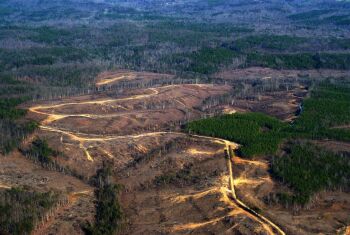 Every bit of sediment that runs off this clearcut goes into streams on public land.
Thus, learning about better ways to manage forests can lead a landowner to being
a better neighbor, both to other landowners and to the public at large.
Every bit of sediment that runs off this clearcut goes into streams on public land.
Thus, learning about better ways to manage forests can lead a landowner to being
a better neighbor, both to other landowners and to the public at large.
When timber harvesting is not done in a responsible manner, the
land and people suffer. Streams can be choked with sediment; wildlife can
be killed. Neighboring landowners can have their lands and waters degraded
and their property values diminished. The landowner whose forest is
mangled through bad forestry practices suffers the most, losing soils,
productivity, wildlife, the beauty of their land, and even future revenues. Why
do so many logging operations damage the very land that is harvested?
Simply put, the large multinational corporations that drive the world timber
market demand that fiber be provided to them in the most efficient and
profitable manner, for them. Massive cut-and-run
clearcutting is the best way to get trees off land and into the hands of large
pulp and timber corporations, but it is not the best way for an individual
landowner to make money and maintain the integrity of their land.
Industrial harvesting methods, such as clearcutting, cause great damage to land,
wildlife, water quality and scenic beauty. Clearcutting done wrong can
also destroy a landowner's future chances of making good money from that land. But
when land owners have more information about their choices, they can make better
decisions about forest management and avoid the problems that come when improper
methods are forced on them. Landowners can decide to manage their land in
a way that maximizes revenue for them (as opposed to maximizing revenue for
corporations) while also protecting the soils, wildlife, water and beauty that
makes that land special to them. Methods such as selective logging can
provide great revenue from sawtimber without ever removing the majority of the
trees from the forest. Landowners who cut selectively and who wisely chose
to take their timber to a quality sawmill have made more money from their land
than neighbors who clearcut and just sold the trees for pulp to the nearest
multinational pulp mill. Sustainable forests come from knowledge
and landowner care, and smart choices about forestry methods require
research. The Alliance seeks to aid landowners in making intelligent
choices about how to manage their forests for now and for future generations to
come.
|